
A business line of credit gives you flexible access to funding exactly when you need it. Unlike a traditional loan, you don't receive a lump sum up front. Instead, you draw only what you need and pay interest on the amount you use. It can help you handle seasonal dips and jump on growth opportunities without locking you into fixed payments.
A business line of credit is a revolving loan that gives you access to a set pool of funds you can draw from, repay, and reuse, paying interest only on what you use. This makes it useful for covering short-term costs, managing gaps in cash flow, or handling unexpected expenses without dipping into reserves.
Unlike a traditional loan, you're not locked into fixed payments. You control how and when to access funds. Lines of credit are the top product for 36% of large banks and 17% of small banks, showing their growing role in mainstream business lending, Ramp reports.
Lenders set your credit limit based on factors like revenue, time in business, and credit history. As you repay, those funds become available again without the need to reapply.
A traditional small business loan gives you a lump sum with fixed repayment terms. You start paying interest immediately, whether or not you use the full amount. With a line of credit, you borrow only what you need, when you need it, and pay interest on the drawn amount.
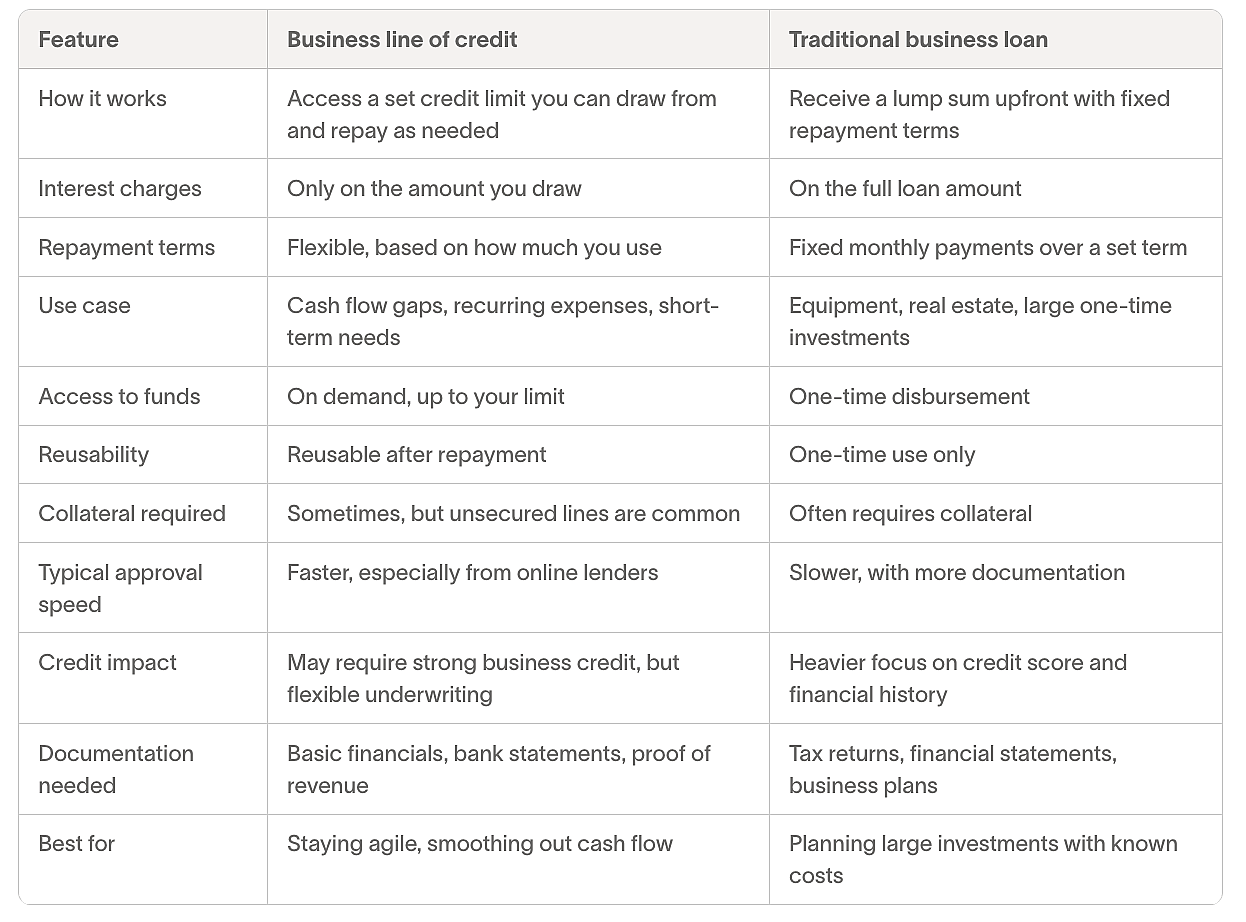
Some companies need fast access to working capital to manage cash flow. Others need structured business financing for larger, planned expenses. Lenders offer different types of credit lines to match these needs based on how your small business operates, your assets, and how predictable your revenue is.
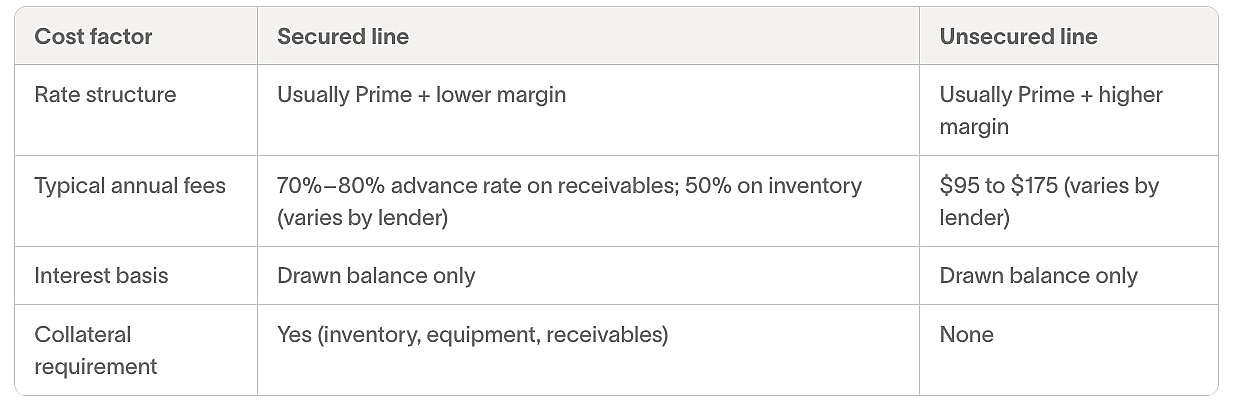
The main distinction comes down to secured vs. unsecured options: Secured lines require collateral and typically offer higher limits with lower rates, while unsecured lines trade those benefits for speed and simplicity.
Secured business line of credit
A secured business line of credit requires you to back your credit with collateral. That collateral can be inventory, equipment, accounts receivable, or other business assets. If you default, the lender can seize those assets to recover losses.
As the risk is lower for lenders, you can usually qualify for higher limits and lower interest rates. For example, according to the Office of the Comptroller of the Currency's most current guidance on accounts receivable and inventory financing, banks commonly advance 70%–80% of eligible receivables as the basis for a credit limit. This makes secured lines a practical choice if you need consistent access to capital but don't want to pay high interest.
If your business owns valuable assets and has a strong repayment plan, this option gives you more leverage. It's especially common in asset-heavy industries like manufacturing, wholesale, and construction.
Choose a secured small business line of credit if you operate in an asset-heavy industry and want to maximize your credit limit while minimizing your interest rate. You'll need to be comfortable pledging equipment, inventory, or receivables as collateral.
Unsecured business line of credit
An unsecured business line of credit doesn't require you to pledge any assets. Instead, lenders look at your business credit score, annual revenue, and time in business to determine your eligibility.
This type of credit is ideal if you run a service-based business or operate without heavy equipment or inventory. It's also helpful if you want to protect your assets while still accessing flexible capital.
As there's no collateral, lenders take on more risk. That means you usually have higher interest rates, and credit limits are tighter. Still, the tradeoff can be worth it if speed and simplicity matter more than size.
Many fintech lenders now offer unsecured lines of credit with streamlined applications and minimal paperwork. According to the Federal Reserve's Small Business Credit Survey, 31% of applicants to online lenders were fully approved for the financing they sought in 2023, and 70% received at least partial approval.
That approval rate applies broadly to loans, lines of credit, and cash advances rather than to lines of credit specifically. But it still points to online lenders as a viable option, particularly for businesses that don't meet a traditional bank's full underwriting bar but can still walk away with some financing.
Revolving business line of credit
A revolving line of credit gives you ongoing access to funds up to a set limit. As you repay what you borrow, that amount becomes available again without the need to reapply.
This structure is built for flexibility. You can draw funds as needed, repay on your schedule, and reuse the credit as your business needs change. It's ideal if your cash flow is unpredictable or tied to seasonal cycles. E-commerce businesses, for example, often rely on revolving credit to smooth out seasonal cash flow swings between peak and slow periods.
Most business lines of credit fall into this category. Revolving credit works well if you need to make frequent purchases, manage short-term gaps, or maintain a buffer for unexpected costs. It keeps your capital accessible without locking you into a long-term commitment.
Non-revolving business line of credit
A non-revolving business line of credit gives you a fixed amount of funding option. Once you use and repay it, the account closes. You can't borrow again without applying for a new line.
This type is useful when you need short-term access to capital without ongoing borrowing. It gives you flexibility on how you use the funds, but you can't draw again after repayment.
You may get better terms than with a revolving line, like lower fees, fewer conditions, or faster approval, as the lender limits long-term exposure. That makes it a good fit for planned, one-time expenses where you don't need continued access to credit.
Here's an example: A contractor takes a single $40,000 draw from a non-revolving line to purchase a specialty excavator. They repay the balance over the 12-month term, and the line closes. If another equipment need arises later, they apply for a new line.
Once you're approved for a business line of credit, it works differently than a business loan. You don't receive funds all at once. Instead, you draw what you need, repay it, and reuse it without having to start over.
Business line of credit interest rates are typically variable and tied to a benchmark like the Prime rate, and you only pay interest on the balance you actually draw.
Understanding the total cost of a business line of credit means looking beyond the interest rate. You'll encounter several potential fees:
Current market rates vary by lender and credit profile. The interest-only-on-what-you-draw structure makes a commercial line of credit rate more cost-effective than a term loan when you don't need the full amount. If you're approved for $100,000 but only draw $20,000, you pay interest on $20,000.
Business line of credit requirements vary by lender, but most share a common set of qualifications. Here's what you'll typically need:
To get approved for a business line of credit, you must show that your company is financially stable, has consistent revenue, and can manage debt responsibly. Lenders want to see that you're running a healthy business and you can repay what you borrow without risk.
Time in business
Start with how long you've been in business. Most lenders require at least 6 months of operations, but some may ask for a full year or more. According to the Federal Reserve's 2024 Report on Startup Firms, startup employers were less likely than older, more established employers to be fully approved for financing. You're already in a stronger position if you've been in business for more than 2 years.
Revenue
Next, look at your revenue. Many lenders set a baseline of around $100,000 in annual income. If you fall below that, you might still qualify, especially if your cash flow is steady and your bank account shows consistent deposits. Fintech lenders tend to be more flexible here than traditional banks.
Credit score
Your credit score also matters to lenders. Most of them will check your personal credit, and they're usually looking for a score of 600 or higher. Some will also check your business credit if you've built a profile. A stronger score can unlock better rates, but qualifying with fair credit is still possible if the rest of your finances are solid.
Business documents
Be ready to share your documents. At a minimum, you'll need to provide recent bank statements, business tax returns, a profit and loss statement, and a balance sheet. Lenders use these to understand your cash flow and see whether you can manage repayments without strain.
Business bank account
You'll also need a business bank account. Lenders use it to verify income and transfer funds if you're approved. If you're applying through a fintech platform, you'll likely connect your account directly during the application process so they can review your financial activity in real-time.
A business line of credit is common among growing companies that need flexibility but don't want to take on long-term debt. The application process is often faster than applying for a business loan.
Online lenders can typically approve and fund credit lines within one to three days, though timelines vary by lender. Traditional banks may take a week or more, depending on how much you're requesting and the complexity of your financials.
A business line of credit offers on-demand capital with interest charged only on what you use, but variable rates and potential fees mean it's not the right fit for every situation.
Pros
Cons
A business line of credit gives you flexible access to working capital without locking you into long-term debt. It's built to manage cash flow, cover short-term needs, and keep your operations moving.
But not every business owner needs one. A term loan might offer better rates if you're planning a one-time investment. If you're consistently running close to your limit or struggling to repay, a credit line may not solve the root problem.
To decide if it's the right fit, look at how and when you spend. A line of credit works best when your cash flow is healthy but uneven, like during seasonal slowdowns or delayed customer payments. If you have consistent revenue, a clear repayment strategy, and a need for flexible funding, it's a strong tool to keep in your financial stack.
Choose a line of credit if:
Consider an alternative if:
Here's a real-world scenario: A retailer experiences a three-month revenue dip every summer when foot traffic slows. A revolving line of credit lets them draw $30,000 in June to cover payroll and inventory, then repay it in September when sales pick up. A term loan would have locked them into 36 months of fixed payments regardless of their cash position.
This story was produced by Ramp and reviewed and distributed by Stacker.


