
Managing corporate credit cards feels like a juggling act for any finance leader. You're constantly chasing down receipts, trying to enforce spending policies, and reconciling statements, all while battling data entry errors.
These challenges waste your time and lead to overspending, compliance issues, and financial discrepancies that can be difficult to track and correct. But as Ramp explains below, that's where corporate credit card management software can help.
The best tools will automate expense tracking, enforce travel and expense (T&E) policies, and provide real-time insights into employee expenses. By adopting the right software, you can replace manual processes with efficient, accurate management, giving you greater control over your organization's finances.
Credit card expense management software helps businesses track and manage spending on company credit cards. These tools streamline the process of recording, categorizing, and approving corporate credit card expenses.
Corporate credit card expense management software makes it easier for you to stay on top of your finances and ensure your employees are spending responsibly. By automating key pieces of the expense management process, including expense policy enforcement, expense reporting, and employee expense reimbursements, these tools help you take control of corporate credit card spending and reduce the hassle of managing expenses.
Beyond streamlining expense claims, approvals, and receipt matching, credit card expense management software helps you:
Access real-time data
Most business credit card expense management solutions give you instant access to spending data as credit card transactions occur. Real-time visibility enables you to make informed decisions quickly, identify trends, and stay on top of budgets without waiting for monthly statements. In fact, a 2023 CPA.com spend management survey found that 97% of SMBs using card-based spend management tools say it helps them stay within budget, compared with just 71% of those relying on traditional processes.
This gap highlights how real-time controls directly translate into stronger financial discipline.
Reduce paperwork and admin tasks
Credit card expense management software eliminates tedious manual data entry and paper receipt filing. Your software should offer automation features for repetitive tasks like tracking and reporting, freeing up your finance team to focus on more important work. Based on Ramp customer data, businesses save an average of four hours each month on accounting tasks thanks to automated transaction coding.
Simplify reconciliation processes
Expense management software automatically matches transactions with receipts, making reconciliation faster and more accurate. It eliminates the hassle of manual matching and ensures your records are always up to date.
Improve budgeting and forecasting
With accurate, real-time data, credit card expense management software helps you track spending patterns and stay within budget. Clear visibility allows for better forecasting, ensuring your financial plans are aligned with actual expenses.
Ensure compliance with company policies
The best solutions automatically enforce your company's expense policy by flagging out-of-policy spending, or blocking it before it even happens. You can see that all expenses are compliant, reducing the risk of unauthorized charges and simplifying the approval process.
Eliminate the reimbursement process
If you're using the right credit card reconciliation software, it will streamline your reimbursement processes. No longer will your team need to keep track of receipts and expense reports because everything happens automatically within the software. And when they are using your issued card, employees don't need to be reimbursed for expenses.
For example, instead of having your sales team front their own money for client dinners, a corporate card handles the charge at the point of sale. There's no out-of-pocket cost for the employee and no reimbursement workflow for your finance team.
Saves you time and money
Before corporate credit card management software, you had to track down expenses, reconcile receipts, and follow approval processes that could take up a lot of your time. And that time could better be spent working on your business. Integrations with your current accounting software, real-time expense tracking and reconciliation, and accurate and automated credit card transaction matching all save you time—and, ultimately, money.
When evaluating credit card management software, make sure the feature set aligns with your business needs. You shouldn't pay for more than you need, but at the same time, you want to ensure the tool can scale with your business as it grows and your needs change.
As you compare expense management platforms, these features should be non-negotiable:
Once you narrow your options, make sure to consider these key factors before making your final decision:
Scalability
Choose software that can grow with your business. As your company expands, your expense management needs will, too. Make sure the software can handle more users, cardholders, transactions, and features as you scale.
Customer support and training
Reliable customer support across multiple channels is crucial. Look for software that offers responsive support and training resources to help your team get up to speed quickly. Good support ensures that you can resolve issues quickly and keep things running smoothly.
Security and compliance
Your software should give you peace of mind that any sensitive financial data is safe. Look for a platform that offers robust security features and guarantees compliance with industry standards.
Integrations
Make sure your chosen software supports the necessary enterprise resource planning (ERP) and accounting integrations. Smooth integrations save time, reduce errors, and help maintain consistent expense data across systems.
Cost and budget
Ensure the software aligns with your budget while providing the necessary features and functionalities. Look for transparent pricing with no hidden fees so you know exactly what you're paying for. Many expense management solutions charge a monthly fee per user, so always check and compare different platform billing options.
Customization options
Choose software that allows you to customize features to your business needs. This ensures the platform works the way you do, helping you create workflows, settings, reports, and dashboards that fit your unique processes.
Effective corporate credit card management starts with the right habits, not just the right software. Once your platform is in place, these six practices help your finance team stay in control:
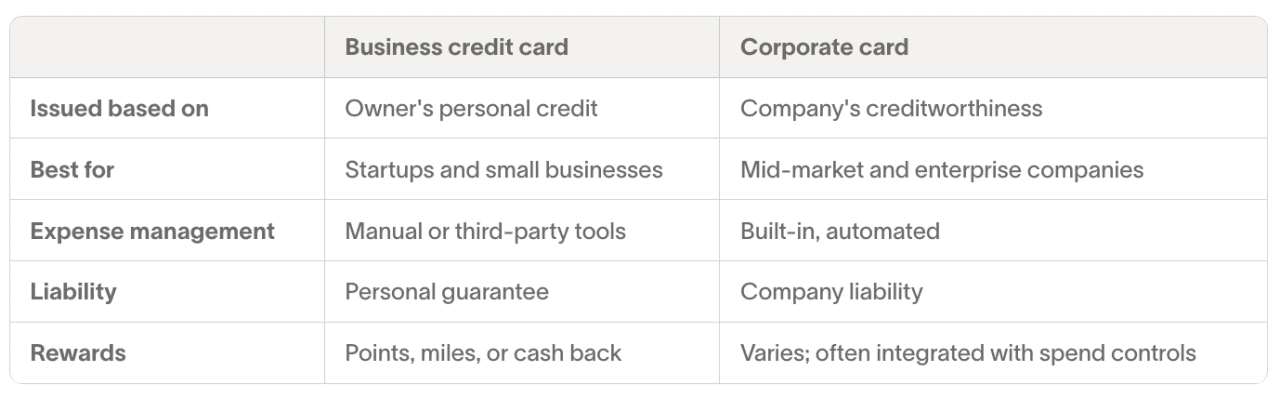
If you're evaluating corporate card expense management options, understanding the difference between a business credit card and a corporate card is a good starting point. Both cover company spending, but they serve different needs depending on your organization's size and complexity.
Lenders issue business credit cards based on the owner's personal credit history. If you're running a startup or small business, these cards are often easier to qualify for. They typically come with rewards programs and don't require a separate corporate credit agreement.
The trade-off is that expense management is typically manual unless you pair the card with a third-party tool.
Lenders issue corporate cards based on the company's creditworthiness, and they work best when you have multiple cardholders. Most corporate card programs include built-in expense management software, giving you centralized control over spending limits, automated policy enforcement, and real-time transaction tracking. These features become critical as your team grows.
This story was produced by Ramp and reviewed and distributed by Stacker.


