
You replaced your heating, ventilation, and air-conditioning (HVAC) system last year, upgraded to modern LED lighting throughout your shop, and maybe even added solar panels to the roof to improve efficiency. What you might not realize is that the federal government set aside real money to reward exactly those decisions, and small businesses are very much included. Energy tax credits are not just for homeowners or Fortune 500 companies with sustainability departments. If you own or lease a commercial space, or have made qualifying energy-efficient building improvements, there are credits and tax deductions worth knowing about before you file your 2026 federal income tax return.
The Inflation Reduction Act, passed in 2022, locked in and expanded many of these federal incentives, although some personal credits have expired, with business-related credits set to follow in 2026. 1-800Accountant broke down the main federal energy tax credits available to small businesses who qualify and how to claim them correctly if you do.
Before getting into the specific credits your business may be able to use, it helps to understand why credits are worth more than deductions. A deduction lowers your taxable income, which indirectly reduces what you owe. A credit directly reduces your actual tax bill, dollar for dollar.
For small businesses with modest tax liability, that distinction matters. A $5,000 credit is worth exactly $5,000 off your bill. A $5,000 deduction might only save you $1,100 or $1,500, depending on your tax bracket.
These are the credits most likely to apply to your business in 2026, while something like a residential clean energy credit wouldn't. Each has different eligibility rules, dollar limits, and filing requirements, so it pays to understand that before making a claim.
You may be able to claim credits like the ITC if your business installed:
The current rate is 30% of the qualifying system's total cost.
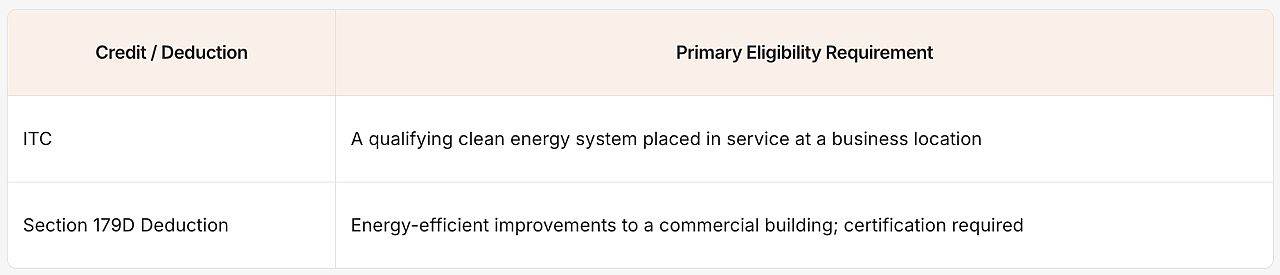
This credit applies to systems placed in service at your business property. A retail shop, warehouse, office building, or home used partly for business can qualify, provided the system meets IRS standards. The ITC is claimed on IRS Form 3468, Investment Credit, and is reported on IRS Form 3800.
Two bonus credits are worth understanding. Systems using domestically produced components may qualify for an additional percentage, and businesses in designated "energy communities" may claim an adder on top of the base 30%. Both require careful documentation to claim successfully.
It's also important to understand related construction milestones. If you start on or before July 4, 2026, your project qualifies for the full credit as long as it is placed in service by Dec. 31, 2030. If you start after July 4, the project is eligible if it is placed in service by Dec. 31, 2027. For more information, view the IRS commercial buildings energy efficiency page.
Section 179D is one of the most valuable and least-discussed tax benefits for small business owners who own or improve commercial property, which will impact energy costs. It allows you to deduct the cost of qualifying energy-efficient improvements, with a maximum of up to $5.94 per square foot for buildings that meet the highest efficiency standards. Deductions are also available for partial compliance.
Qualifying improvements include interior lighting systems, HVAC and hot water boilers, heat pump water heaters, central air conditioners, and building envelope upgrades like insulation, exterior windows, and exterior doors. Under the Inflation Reduction Act, the maximum deduction amount and the range of eligible claimants expanded significantly, and those rules carry through 2026. Designers and contractors who work on government-owned or tax-exempt buildings can also claim the deduction, since those entities cannot use it themselves.
Keep in mind that Section 179D claims require a certification from a qualified engineer or contractor confirming the energy savings. This is not something you self-certify, so factor that installation cost into your evaluation of smaller projects.
Eligibility varies by credit, but a few common requirements apply:
Pass-through entity owners, including S corporations, partnerships, and limited liability companies, can claim these credits on their personal returns through Form 3800.
The Inflation Reduction Act for small businesses introduced "direct pay" and "transferability" provisions for certain credits. Tax-exempt entities and some small businesses may be able to receive credits as direct cash payments or sell unused credits to another taxpayer. The IRS continues to issue guidance on these provisions, and it is a complex area where professional guidance is worth the investment before moving forward with a claim.
The filing process is fairly straightforward once you're familiar with the main steps, but missing any one of them can cause problems and delay the process.
The credit applies to the tax year in which the system is placed in service, not to the year you sign the contract or pay the invoice. This timing detail trips up many filers. If your solar installation was contracted in December 2025 but the system was not operational until February 2026, you claim the credit on your 2026 return.
These credits reward planning. If you are considering multiple improvements, think about staggering them across tax years.
You should also compare the ITC against your depreciation options. When you claim the ITC on a solar system, you must reduce the depreciable basis of the property by 50% of the credit amount. Depending on your situation, a Section 179 expensing election or bonus depreciation might produce a better outcome. Many states also offer energy incentives that stack on top of federal credits, so checking your state's rules before filing can add meaningful savings.
Tax laws can change and often do, and temporary provisions can be made permanent. Verify current IRS rules before claiming any credit or deduction, particularly if you handle your own tax work. For a broader idea of what is available to your business beyond energy, reviewing your possible eligibility for all small business tax credits is a useful starting point.
Energy tax credits represent real, dollar-for-dollar savings for small businesses that invest in efficiency, but claiming them correctly requires accurate documentation, an understanding of how they interact with depreciation, and attention to timing.
Can I claim the ITC if I lease my business space rather than own the building?
Yes, in most cases, you can claim this credit whether you lease or own. The ITC is tied to ownership of the energy system, not ownership of the building. If you purchase and install a qualifying solar system on a leased commercial property and own the system, you can generally claim the credit. You will want a written agreement with your landlord confirming equipment ownership, and reviewing the IRS guidance before proceeding is always a smart step.
Does claiming the ITC affect my depreciation deduction for the same property?
Yes, and this is one of the most commonly missed details. When you claim the ITC on a qualifying system, you must reduce the depreciable basis of that property by 50% of the credit amount. So if you claim a $30,000 ITC on a $100,000 solar installation, your depreciable basis drops by $15,000. Running both scenarios before filing helps you understand the full tax picture before you commit.
What documentation do I need to support a Section 179D deduction?
Section 179D requires more paperwork than most deductions. You will need a certification from a qualified engineer or licensed contractor confirming that the improvements meet IRS energy-efficiency standards, prepared using IRS-approved software, and including specific information about the building and projected energy savings. Keeping original invoices, contractor agreements, and efficiency certifications in a secure, centralized location is essential, since the IRS may request them if your return is reviewed.
What happens if my energy tax credit exceeds my tax liability for the year?
Business energy credits that exceed your current-year tax liability generally can be carried back one year or carried forward up to 20 future years, depending on the specific credit. The General Business Credit rules govern how carrybacks and carryforwards work, and they apply to most business energy credits that flow through Form 3800. Planning your credit timing around years when you expect higher tax liability can make the carryforward more valuable.
This story was produced by 1-800Accountant and reviewed and distributed by Stacker.


